

YOUR HOME SOLD GUARANTEED OR WE'LL BUY IT!*





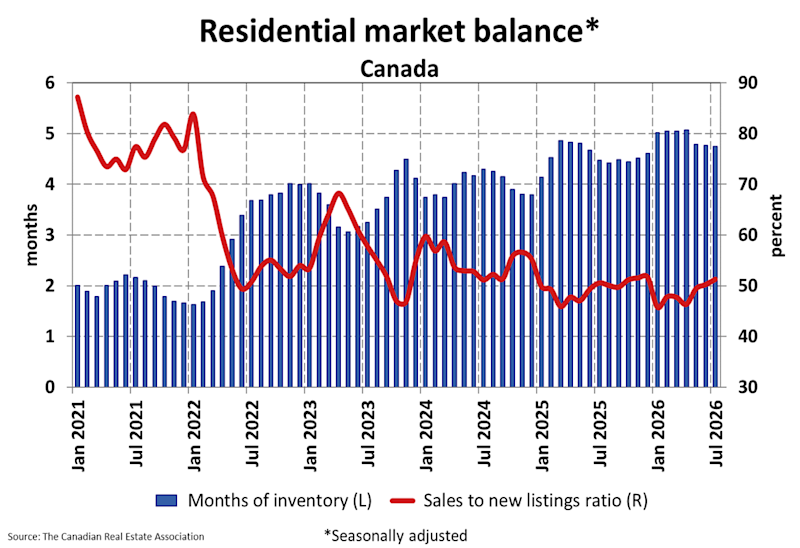
Canada’s housing market continued its gradual shift toward balance in July 2026, with national home sales increasing 0.5% from June and marking a fourth consecutive monthly gain. Despite the improvement, actual sales remained 5.3% below July 2025 levels. New listings declined 1.6% for a third straight month, bringing the national sales-to-new-listings ratio to 51.3%, closer to the long-term average of 54.7%. This suggests that supply and demand are moving toward more typical market conditions across much of the country.
Housing inventory also remained relatively stable, with 205,388 properties listed for sale at the end of July, just 0.6% higher than a year earlier and close to the long-term average. National inventory stood at 4.7 months; the lowest level recorded so far in 2026 and slightly below the long-term average of five months. While some regions remained closer to seller-friendly conditions, markets across the Prairies, Quebec, Atlantic Canada, Ontario and British Columbia have generally been moving toward more balanced conditions. Even areas that began the year in buyer-friendly territory have shown signs of returning closer to historical norms.
Home prices were largely stable during the month. The national MLS® Home Price Index edged up 0.1% from June, marking its first monthly increase since November 2024, while remaining 3.3% below July 2025 levels. The pace of annual price declines has been narrowing since the start of the year. The national average home price reached $674,819 in July, up 0.2% from the same month last year. Overall, the combination of steadier prices, moderating inventory levels and improving supply-demand balance points to a housing market that is gradually returning to more normal conditions.